How to Get Your Med Spa Recommended by ChatGPT
By Tatiana, founder of iQyra · We help med spas get found in Google and AI search.
Getting recommended by ChatGPT comes down to three things, and none of them is a hidden setting. Give the assistant a concrete reason, on the page, that it can quote for preferring you. Make sure independent sources agree on your facts. And answer the exact criteria a patient puts into the question. Being in the answer and being the name a patient reads first are two different bars. A patient asks, “Where's the best place near me for lip filler?” and gets back a short list with a reason for each. You can be one of those names and still not be the one it recommends. This piece is about clearing the second bar.
First, the limits. No one can see inside ChatGPT's ranking, you can't buy your way into its organic answer, and OpenAI says a top spot can't be guaranteed. If your clinic isn't surfacing in AI answers at all yet, start one step back with why your med spa doesn't appear in ChatGPT — you have to be readable before you can be preferred. What follows assumes you clear that bar and want the recommendation.
Being recommended is a comparison, not a lookup
When a patient asks for the best place for a treatment, an assistant doesn't simply find you. Judging by how these answers come back, it lines up a few candidates, weighs them against what the patient asked for, and names one or two with reasons. You're competing in a side-by-side you never see, on facts you may never have put on the page. So the question stops being “can it find me?” and becomes “when it compares me to the clinic down the road, what does it have to prefer me on?”
Across the recommendation tests we run, three patterns show up repeatedly. They're not the same as the gaps that keep you out of the answer entirely — those are about being extractable. These are about being chosen:
To prefer you, an assistant needs a concrete, on-page reason: a named provider with credentials, who the treatment is for, a real price range, a written plan. “Expert team, personalized care” gives it nothing to pick you on.
A recommendation is a bet. The more independent places — business profile, reviews, directories, local press — state the same facts about you, the easier it is to name you with confidence.
Recommendation questions carry constraints: “physician-led,” “natural-looking,” “good for early jowls,” “clear pricing.” You win when your page visibly satisfies those exact conditions.
Notice what's missing from that list: how impressive your site looks. A recommendation is won on what an assistant can quote and corroborate, not on your hero video.
Recommendation questions carry hidden criteria — meet them on the page
The recommendation prompts that matter most carry constraints: “a physician-led place for a subtle thread lift for early jowls, with clear pricing.” Every one of those is a test your page either passes or fails. When an assistant reshapes that question and checks sources, it appears to look for the clinic whose page answers those exact conditions. Here's how the common ones map:
| What the patient asks for | What your page has to make explicit |
|---|---|
| “Who actually does it? Physician-led?” | A named provider with title and credentials, on the page — not just “our team.” |
| “Is it right for me? (early jowls, mild laxity)” | Explicit candidacy: who it's for, and who it isn't. |
| “Will it look natural / subtle?” | Your described approach and the kind of case you treat, in plain words. |
| “How much does it cost?” | A real price or range on the page, not “price on consultation.” |
| “Will someone assess me first?” | A mention of evaluation and a written plan before treatment. |
Most med spa pages answer none of these above the fold. They lead with a tagline and a “Book now” button, and leave the provider, the candidacy, and the price for a human to dig out after the click. A human may dig for it. An assistant comparing several clinics may never surface it — it names the one that already answered.
Some of the strongest prompts are about safety, not style
Not every recommendation question is about price or a natural look. In medical aesthetics, a lot of them are about trust: “safest place for Botox,” “an experienced injector,” “a doctor-led med spa,” “somewhere that handles complications,” “best place for someone new to fillers.” For those, the decision-useful facts are different — and usually missing from the average med spa page:
| What the patient is really asking | What your page has to make explicit |
|---|---|
| “Is this safe?” | Provider credentials, realistic risks, and honest contraindications |
| “What if something goes wrong?” | Your follow-up and complication protocol, where relevant |
| “I don't want to be overtreated” | A conservative approach, and assessment before treatment |
| “Am I even a candidate?” | Exclusions as well as indications — who it isn't for |
Price, candidacy, provider, and a treatment plan give an assistant useful grounds for comparison. For a nervous or first-time patient, safety and clinical confidence are often what win it — and stating them plainly is a reason to prefer you that most competitors leave off the page entirely.
Why does ChatGPT recommend a competitor with a worse website?
This is the part that stings. You can have the more beautiful site, the bigger following, the nicer photos, and still lose the recommendation to a plainer page down the street. Not because the assistant likes them more, but because their page said, in plain words, who does the treatment, who it's for, and what it costs — and yours said “experience the art of aesthetics.” Filler used to just annoy readers. Now it can make you invisible to the thing choosing between you and the clinic next door.
The fix isn't to strip the personality out of your site. It's to make sure the answer sits above the story, so that when a machine compares you on the patient's terms, there's something concrete to prefer you for.
Specific beats big
Owners often assume the recommendation goes to the largest, best-known brand. For a broad query, it sometimes does. But recommendation questions are specific by nature — a city, a treatment, a candidacy, a preference. And a precise local match tends to get named over a vague national chain that never states which of its locations does early-jowl thread lifts or what they cost. You don't out-spend the big brand. You out-specify it: the exact treatment, in the exact city, for the exact patient, with the facts stated plainly.
You don't need one universal reason to win
There's no universal “best med spa in ChatGPT.” A clinic is the best match for a particular set of conditions — and different clinics win different questions. One gets named for clear pricing, another for being physician-led, a third for natural-looking results, a fourth for being experienced with older patients, a fifth for budget.
That reframes the whole goal. The useful question isn't “how do I become number one?” It's “for which recommendation questions do I have a real, defensible reason to be the answer?” Pick the intents you can honestly win — your actual specialties, your real strengths — and make the page state them plainly. You don't have to be everyone's recommendation. You have to be the obvious one for the patients you're genuinely best for.
The reasons an assistant gives are the facts you put on the page
When an assistant recommends a clinic and explains why, look closely at what the reasons are made of. In the tests we run, they aren't adjectives — they're the concrete facts the page stated: who performs the treatment, who it's for, a realistic price range, that an evaluation happens first. The assistant isn't reading the clinic's mind. It's repeating what the page made easy to find, and citing that page as the source.
Here's one such test. We ran an unbranded, patient-style prompt in ChatGPT — asking it to recommend and compare five Scottsdale providers for a subtle PDO thread lift for early jowls, prioritizing physician evaluation, candidacy, natural-looking results, and upfront pricing, and to cite its sources. It named Desert Bloom Skincare first. The reasons it handed back were the selection criteria straight from the prompt: clear pricing, a real discussion of candidacy, that the page lists mild-to-moderate jowls and jawline laxity as ideal indications, and a written treatment plan before proceeding. Those weren't slogans — they were concrete facts surfaced on the page, and ChatGPT cited that page as its source. You can see the actual ChatGPT conversation.
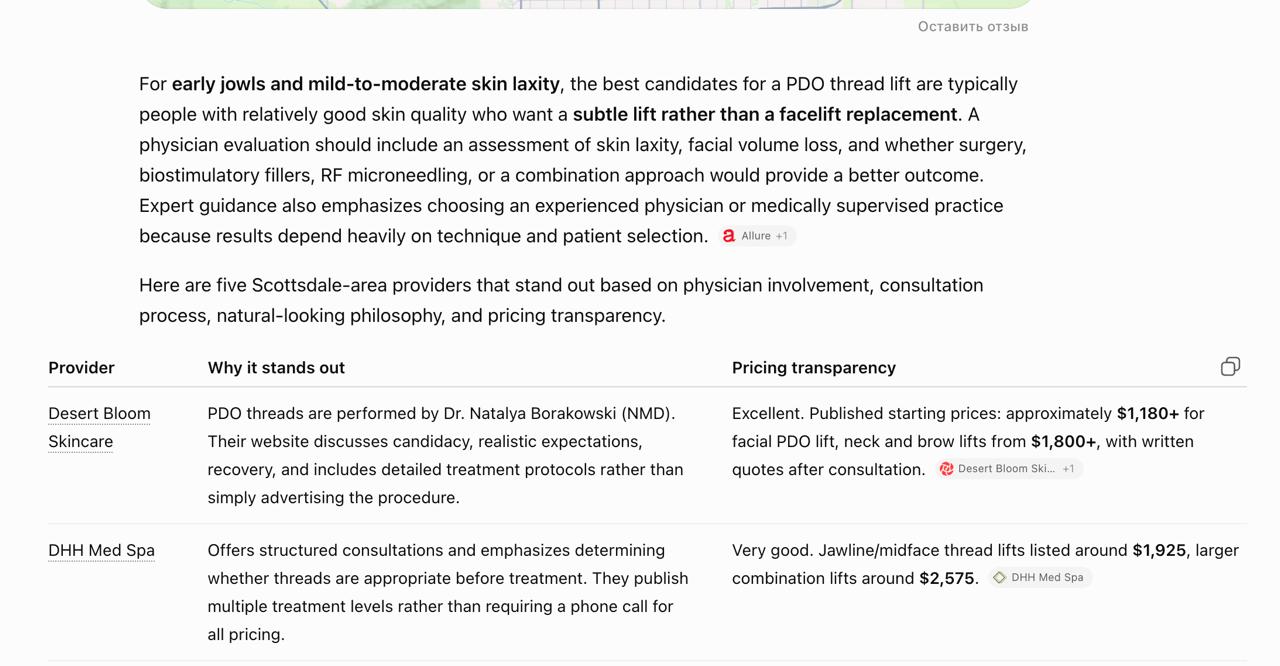
One answer doesn't establish a ranking rule, and we won't pretend it does. But it shows the pattern cleanly: the reasons a recommendation gives back are the facts you chose to surface. Put nothing decision-useful on the page, and you hand the assistant nothing to recommend you with. (Being extractable enough to enter that shortlist in the first place is the earlier problem — that's what appearing in ChatGPT covers.)
A recommendation isn't won by guessing the algorithm. It's won by stating, on the page, the reasons you'd want an assistant to repeat — and having other sources say the same.
Give the recommendation something to stand on
An assistant appears more willing to name you when the outside world agrees with your page. That agreement is less about volume and more about consistency: your Google Business Profile, your reviews, your directory listings, and your own site should describe the same clinic — same name, same location, same services, same specialties. When those line up, a recommendation has somewhere firm to stand. When they contradict each other or barely exist, an assistant has a reason to reach for a cleaner-looking competitor instead.
This is where AI visibility and ordinary local SEO stop being separate projects. A complete, accurate Google Business Profile and real reviews do double duty: they help patients find you in Maps, and — in the tests we run — clinics whose facts line up across their own site and independent profiles tend to earn more confident recommendations. What OpenAI publishes is narrower than that: ChatGPT Search can draw on external web and third-party sources, but it doesn't say which specific profiles or reviews it weighs, or how. So treat the corroboration as something we observe helping, not a documented ranking lever. It's the same work — what some now call generative engine optimization — pointed at a second audience, and it's most of what our AI-visibility audit checks.
You can't buy or guarantee a recommendation — so measure it (the Recommendation Test)
Because there's no published ranking and no paid way to influence the organic recommendation, the only reliable read is your own testing. Don't trust one lucky answer. Build a small set of comparative, patient-style prompts — the kind that ask for the best options and reasons — and run them consistently. For example:
“Recommend 5 physician-led clinics in [your city] for a subtle PDO thread lift for mild-to-moderate jowls. Compare candidacy, pricing, provider credentials, and treatment planning. Cite your sources.”
Treat it like an experiment, not a screenshot contest. Run the same prompt in a fresh chat, from the same location, under the same conditions, and repeat over time. The fresh chat matters: OpenAI says ChatGPT Search can take the current conversation into account when it reshapes its searches, so a prompt asked after a twenty-minute conversation about your clinic isn't a clean benchmark.
And log more than “did I appear.” Separate presence (were you in the running) from preference (were you the pick) — they improve for different reasons:
| Metric | Example |
|---|---|
| Candidate presence | named in 7 of 10 tests |
| First-choice rate | #1 in 2 of 10 |
| Recommendation reason | pricing cited in 6 of 10 |
| Competitor win reason | credentials in 5 of 10 |
| Supporting source | your service page / GBP / a third party |
That gives you what we call a recommendation share over time, not a binary “ChatGPT likes me / it doesn't.” The reasons and the competitors are the most useful columns: they tell you which criteria are deciding the pick, and what the clinics beating you are being credited for — usually a fact they stated and you didn't. OpenAI also notes that location affects local results, so run your prompts the way a local patient would, and read the pattern over weeks, not any single reply.
Frequently asked questions
What's the difference between appearing in ChatGPT and being recommended by it?
Appearing means you're one of the sources or names that surface. Being recommended means the assistant names you as a preferred choice and gives reasons. Appearing is the prerequisite; being recommended is winning the comparison it runs among the candidates. They need different things: extractable facts to appear, and quotable reasons plus outside agreement to be preferred.
Why does ChatGPT recommend a competitor with a worse-looking website?
Because a recommendation rewards the page that answers the patient's criteria most clearly, not the prettier design. A plain page that states the provider, candidacy, and price gives an assistant something to cite. A beautiful page that hides those behind a booking widget gives it nothing to justify choosing you with.
How do I get my clinic recommended by ChatGPT?
Make the reasons you'd want it to repeat impossible to miss on the page — named provider and credentials, who the treatment is for, a real price range, and that an evaluation happens first — then make sure your Google Business Profile, reviews, and listings state the same facts. Then measure with unbranded, comparative prompts and adjust based on the reasons it gives back.
Does ChatGPT recommend clinics based on Google reviews?
OpenAI doesn't publish which signals it weighs. ChatGPT Search can pull from web and local sources when answering recommendation questions, so reviews and third-party profiles that consistently describe the same services and specialties give it more to stand a recommendation on. Treat reviews as part of the outside agreement, not a switch you flip.
Can I pay to be recommended by ChatGPT?
No. ChatGPT now shows paid ads in some experiences, but OpenAI says ads are kept separate from its answers — you can't buy influence over its ranking or which clinics it recommends, and an ad isn't an endorsement. What you can control is whether your page states the reasons a patient asked for, and whether independent sources back them up.
How many sources need to agree before ChatGPT will name my clinic?
There's no published number. The practical goal isn't a threshold, it's consistency: your business profile, reviews, directory listings, and your own pages should describe the same name, location, services, and specialties. Contradictions or thin coverage give an assistant less reason to name you over a cleaner-looking competitor.
See which clinics ChatGPT recommends instead of yours
Our audit runs the comparison for you: whether AI assistants can find your clinic, verify its claims, tell it apart from local competitors, and justify recommending it — plus which rivals they name in your place, and the reasons they give.
Get a free iQyra AI-visibility audit