Why Your Med Spa Doesn't Appear in ChatGPT (and What to Fix First)
By Tatiana, founder of iQyra · We help med spas get found in Google and AI search.
Patients are asking ChatGPT for “a good med spa near me,” and if your clinic isn't in the answer, it's worth understanding why. We can't see inside ChatGPT's ranking, and no one can promise you a top spot. But when a med spa is missing from AI answers, the problem almost always sits in one of three layers:
Can an assistant fetch your page? If your site blocks the search crawler, the rest of your on-page work can't help that page become a usable source.
Once it has the page, can it pull the facts it needs — price, who a treatment is for, downtime, who performs it — and are those written as clean, quotable text instead of buried in design?
Can it confirm those facts somewhere else — your Google Business Profile, reviews, mentions — enough to treat you as a real, credible clinic?
Work through them in that order, because a later layer can't save an earlier one: the most quotable page in town is invisible if the crawler never reaches it.
A quick way to tell which layer is yours:
| If… | Check first… |
|---|---|
| your clinic never appears at all | Access — run the AI Crawler Checker |
| you appear for your brand name but not “treatment + city” | Extractability — are the service and location stated as plain facts? |
| an assistant gets your price, provider, or candidacy wrong | Extractability — are the facts consistent and unambiguous? |
| your page is cited but your business details look thin | Corroboration — profile, reviews, mentions |
| you already show up next to competitors | you're past this — see how to get recommended |
The pattern we see in our tests: a clinic is easier for AI search to surface when its facts are easy to extract and corroborate elsewhere. The change isn't that patients stopped visiting websites — it's that more of them now ask an AI assistant to narrow the field first. Your clinic has to be visible in that shortlist before anything else can happen. All three layers are fixable, and none of them needs a bigger ad budget.
How does ChatGPT Search find clinics to include in an answer?
There's no ranking you can buy your way into, and OpenAI says top placement can't be guaranteed. What OpenAI does tell us is useful: when you ask ChatGPT Search a question, it may rewrite your question into one or more targeted searches, look at the results, and run more searches to refine the answer. A patient might type “Where should I go for a subtle thread lift near Scottsdale?” ChatGPT Search doesn't necessarily search those exact words. It may reshape the question and check several sources before answering.
That has a practical consequence. Your page needs to make a handful of things unmistakable: what you do, where you do it, who it's for, who performs it, and what makes the treatment appropriate. The clearer those are on the page, the easier it is for searches around those criteria to retrieve relevant information about your clinic.
So the question isn't “is my website impressive?” It's “can an AI reach my page, extract my facts, and find someone else confirming them?” Those are different bars, and most med spa sites clear them for humans while making them hard for a machine.
| A human visitor sees | An AI assistant works with |
|---|---|
| Hero video, warm tagline | Few explicit decision-making facts |
| “Book now” button | No price, candidacy, or downtime |
| Price after a click, or inside a booking widget | Little it can quote directly |
| Beautiful photos | Useful visually, but not a substitute for explicit factual text |
| Story first, facts later | Key facts are harder to retrieve and quote |
Why is my beautiful website hard for AI to read?
We see this especially often on highly designed med spa sites. The first screen is a hero video and a tagline. The price sits three scrolls down, or inside a booking widget that only appears after a click. Candidacy details live on a separate page. The facts a patient asked about are on the site somewhere, but they aren't exposed as plain, easy-to-retrieve text near the top.
A prospective patient sees a gorgeous page. An assistant has very little it can lift into an answer. It's not that your site is bad. It was built to impress a person, not to hand a machine a clean set of facts. For years, med spa copy was optimized around persuasion after the click. AI search adds another requirement: the page also has to make the answer easy to extract before the patient ever reaches it.
Fix 0: Make sure ChatGPT can even reach your page
Before you rewrite a single sentence, check the technical gate. None of the fixes below matter if an assistant can't fetch your page in the first place — and this is the step clinics skip most, because the site looks fine in a browser. Three things to confirm:
- Your robots.txt allows the right crawler. OpenAI uses separate bots, and this trips people up: OAI-SearchBot is the one that fetches pages for ChatGPT Search, and it's different from GPTBot, which relates to model training. They're controlled independently — so you can let ChatGPT find and surface you in search while deciding separately how you feel about training use. For visibility, make sure OAI-SearchBot isn't disallowed.
- Your host or CDN isn't turning the crawler away.This is the one that surprised us on our own site. A page can look perfectly healthy in a browser while a CDN or firewall serves automated crawlers a challenge page or an error instead of the real content — so the assistant sees a block, not your carefully written facts. If you're behind Cloudflare or similar, confirm its bot protection lets verified search crawlers through.
- The page is actually indexable. No stray
noindex, and the page is reachable by a real internal link rather than orphaned.
You don't need a special llms.txt file for this. OpenAI's guidance for showing up in Search is about allowing its crawler and being reachable — not a magic file. Clear this gate first; everything below assumes an assistant can read the page.
Fix 1: Put the answer in the first screen (the 100-Word AI Readiness Test)
Here's the rule of thumb we use. If a patient's core questions aren't answered within roughly the first 100 words of a service page, move them up. Price or range, who the treatment is for, how long it takes, downtime, and the result to expect belong above the marketing story.
This isn't a published ChatGPT rule. It's an editorial test: your page should expose its most decision-useful facts before the narrative begins. We call it the 100-Word AI Readiness Test, and it's the fastest change most clinics can make. Write for the patient, but put the answer first.
What that looks like on a real page
When we restructured a Desert Bloom Skincare PDO thread-lift page, the change wasn't simply moving information higher. We made the information itself more decision-useful — specific candidacy, a realistic price range, downtime, treatment time, and expected duration of results — then moved those facts up. Here's the top of the page before and after:
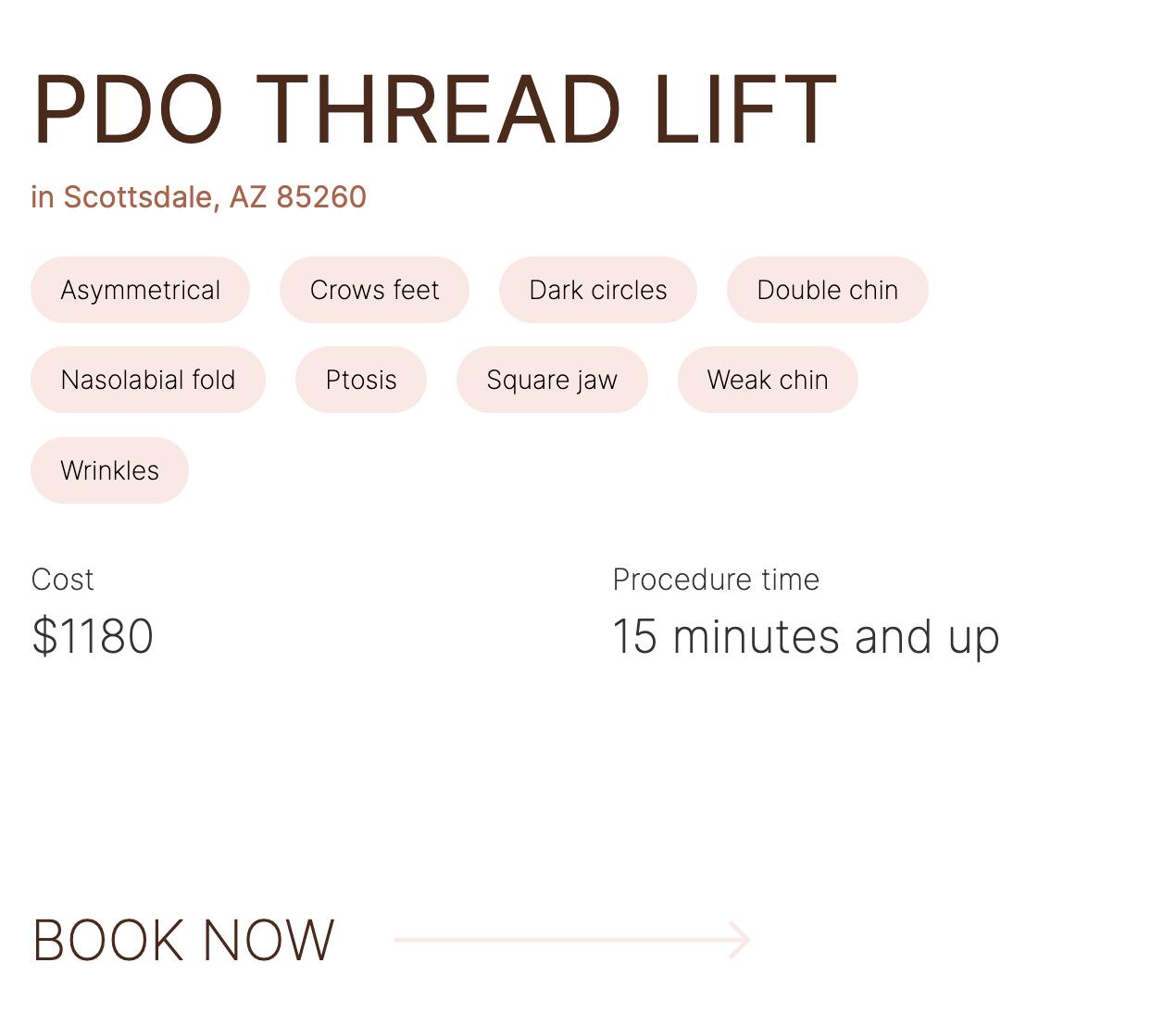
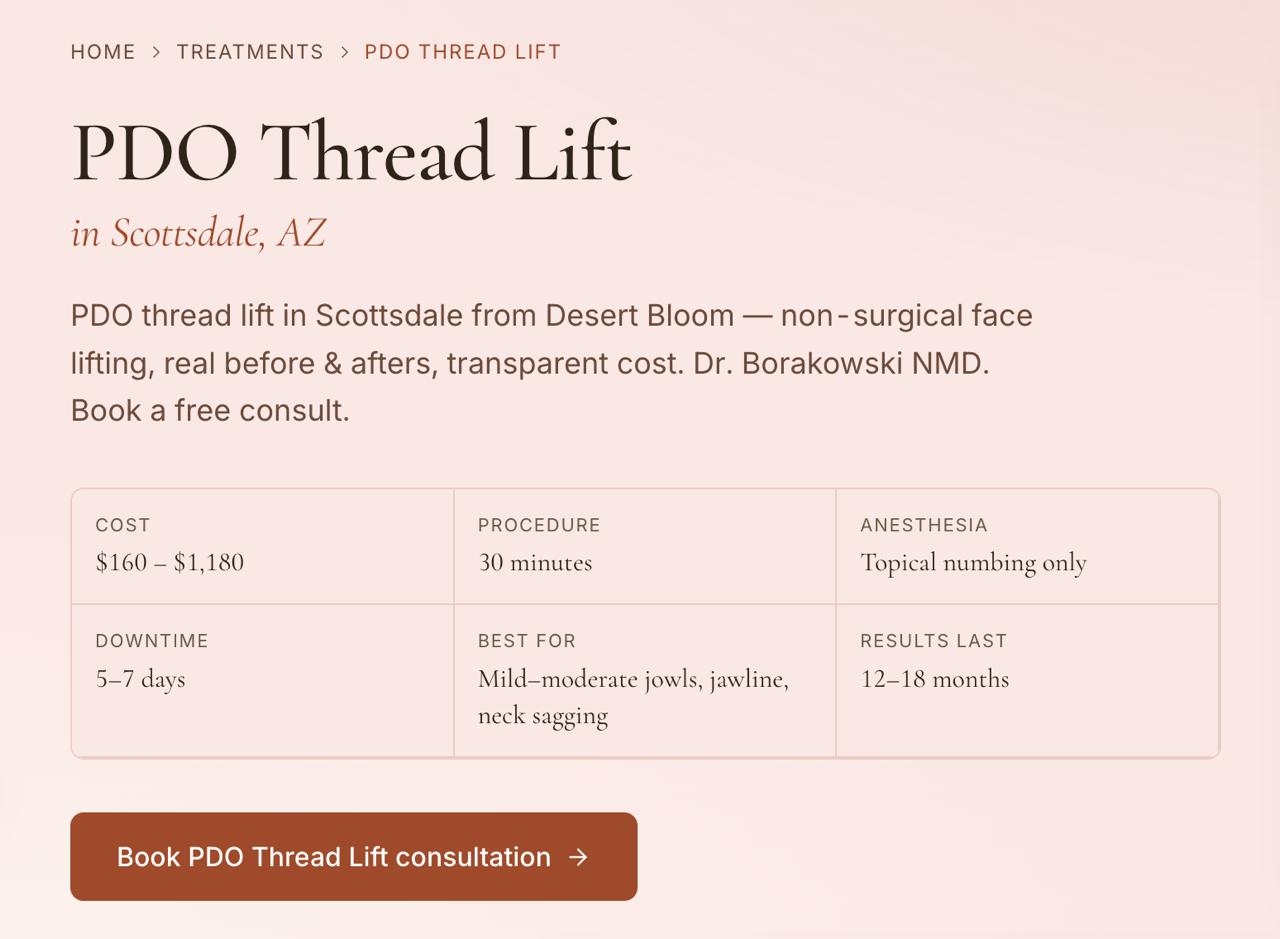
The old page led with persuasion, not answers: “Are you tired of sagging skin and wrinkles? Imagine having firmer, smoother skin… Don't wait, schedule your consultation today.” The real numbers were buried and didn't even agree: the hero showed “Cost $1180,” the text said it “starts from $120,” and procedure time appeared as both “15 minutes and up” and “up to 60 minutes.” The new first screen states one clean, consistent facts block: cost $160–$1,180, procedure 30 minutes, topical numbing only, downtime 5–7 days, best for mild-to-moderate jowls, jawline, and neck sagging, and results that last 12–18 months.
Same clinic. Same treatment. The new page states who it's for and what to expect in terms a patient — and an AI — can actually retrieve.
Fix 2: Give your answers a structure machines can understand
Use descriptive, question-style headings that match how patients actually ask, and write short, self-contained answers that still make sense when pulled out of the page. A clean question-and-answer format is easy for both a patient and an assistant to use — it's the other half of extractability: the facts have to be exposed in a shape a machine can lift, not only present somewhere on the page.
Structured data (schema) can reinforce what a page, business, provider, or service represents, and it remains good technical SEO practice. But don't treat schema as a shortcut into ChatGPT. There's no public confirmation that adding FAQ schema makes an AI quote you, and even Google treats structured data as a way to understand a page, not a general ranking factor. The visible page still has to state the answer clearly. Schema supports that, it doesn't replace it.
Fix 3: Give AI search independent evidence to verify your business
Your own website is one source. Independent brand mentions, business profiles, reviews, and reputable third-party pages give search systems additional places to confirm the basic facts about your clinic. For a med spa, these are practical places to start:
- A complete, accurate Google Business Profile: hours, services, address, photos. It's foundational to local SEO and gives search systems a consistent source of basic business information.
- Review platforms patients trust: Google reviews, Yelp, RealSelf. Keep them accurate and consistent.
- Local press and industry mentions: getting named in local media or aesthetic publications gives a system more independent evidence that you are who you say you are.
You don't buy your way in. You give the outside world consistent, real information that lines up with your own pages, so an assistant can establish that you're a real, credible clinic.
Is this different from regular SEO?
Yes and no. The foundations overlap with traditional SEO: clear content, a fast site, real reviews. Optimizing to be useful in AI answers (sometimes called answer engine optimization or generative engine optimization) adds a layer on top. Search engines and answer engines increasingly reward the same thing: clear, self-contained answers that are easy to retrieve, understand, and cite. Google's AI Overviews and ChatGPT both work better with a direct answer than with a page they'd have to read end to end. You're still doing SEO, plus making every important fact easy to pull out.
How do I check whether ChatGPT surfaces my clinic? (the Visibility Test)
Don't rely on a single lucky question. Build a small set of unbranded prompts a real patient might use, and run them consistently. For example: “List med spas in Scottsdale that offer PDO thread lifts. For each, note what the page says about who it's for, the price, and who performs the treatment, and cite the source.”
Each time, log:
- Did you appear, and how were you described?
- Query class — brand / treatment + city / problem + city / provider-type + treatment. (You can be strong on your brand name and invisible on “treatment + city,” which is the one that matters.)
- Were the facts correct? Appearing with the wrong price, provider, or location is its own failure — not the same as being absent.
- Which source was cited, which competitors showed up, and the date.
One thing to keep in mind: OpenAI says location affects local results, using an approximate location from your IP address, or a precise one if you allow it. So run your prompts the way a local patient would, and track the pattern over time rather than any single answer. If you want to see downstream traffic, ChatGPT currently tags referral links with utm_source=chatgpt.com, so visits show up in your analytics — but treat clicks as a floor, not the whole picture: no click doesn't mean no mention.
How long does it take to appear in ChatGPT?
There is no published ChatGPT timeline, and we won't invent one. A page first needs to be reachable and crawlable — that's Fix 0 — and OpenAI specifically recommends allowing its OAI-SearchBot. After that, visibility can still vary by query, location, competition, and which sources ChatGPT retrieves. Don't promise yourself a 30-day result. Set your baseline prompts, make the fixes, and measure.
Getting surfaced is step one. Being preferred over the clinics beside you is step two. Once your facts are extractable and corroborated, the next question is whether an assistant has a reason to pick you over a similar clinic nearby — a different job, and we break it down in how to get your med spa recommended by ChatGPT.
The 100-Word AI Readiness Test
Fill in your service page and treatment. We build the check for you, then open it in ChatGPT.
Evaluate whether this page gives an AI search assistant enough specific, verifiable information to shortlist this clinic for [treatment] in [city].

Page: [paste your service page URL or text]

What decision-making facts can you extract? What is missing or buried? Which essential answers are missing from the first 100 words? Do not assume facts that aren't stated on the page.
Tip: turn on web browsing in ChatGPT so it can read the page. If it can't, it will ask you to paste the page text, which works too.
Frequently asked questions
Why doesn't my med spa appear in ChatGPT answers?
In our audits, the most common problems fall into three layers: an assistant can't reach the page (a blocked crawler or CDN), the facts a patient needs aren't easy to retrieve, or there isn't enough independent evidence to confirm you. It's often more than one at once — start by checking access, then extractability, then corroboration.
How do I know if ChatGPT can crawl my website?
Check whether your robots.txt allows OAI-SearchBot, the crawler behind ChatGPT Search. Our free AI Crawler Checker does that automatically for the main AI and search bots. A green result means the bot isn't blocked by robots.txt; it doesn't prove your CDN or firewall is letting the crawler through — that's a separate layer.
Do reviews and third-party profiles help ChatGPT verify my clinic?
OpenAI doesn't publish a list of ranking signals. But reviews and third-party business profiles give AI search independent places to confirm the basic facts about your clinic — your name, location, services, and that you're a real, active business. Keeping your Google Business Profile and reviews accurate and consistent with your own pages makes you easier to verify, which can strengthen the evidence available when your clinic surfaces.
How long does it take to show up in ChatGPT after fixing my pages?
There's no published timeline. Make sure your pages are reachable and crawlable (OpenAI recommends allowing OAI-SearchBot), then measure your baseline prompts over time. Treat any single answer as a snapshot, not a verdict.
Do I need to be a big, well-known brand to appear in AI search results?
No. A small local clinic with clear facts, a complete Google Business Profile, and real reviews can be surfaced for a specific city-plus-treatment question, where large national brands often aren't specific enough.
Do backlinks still matter for AI search visibility?
OpenAI doesn't publish a backlink ranking factor. Links still matter to the wider web because they help pages get discovered and referenced and build authority in traditional search. For a med spa, the faster wins are readable facts, clean answers, and local reviews.
Can ChatGPT surface a clinic it has never mentioned before?
Yes, particularly when ChatGPT Search retrieves current web results. A clinic doesn't have to be a nationally recognized brand to become relevant for a specific local treatment query, which is why keeping your current pages reachable, clear, and backed by independent sources matters.
See your clinic through the AI's eyes
The 100-word test shows what's missing from one page. Our full audit checks the harder question: whether AI assistants can reach your clinic, extract its facts, and verify its claims.
Get a free iQyra AI-visibility audit